I’ve been in public education long enough to have seen pendulum swings, policy cycles, silver bullets, and reforms that promised the moon but barely scratched the atmosphere to even create a crater. I’ve seen technology arrive in waves: desktops, laptops, smartboards, tablets; each announced as the evolution that would transform the classroom.
But artificial intelligence is different. It is not a wave. It’s a tide change.
And as someone who champions AI integration in schools, who speaks nationally about the opportunities and responsibilities school leaders hold during this unprecedented transition, I feel obligated to sound an alarm that is both urgent and hopeful.
Because the truth is simple: AI, automation, and robotics are accelerating faster than our education systems, our policy frameworks, and our workforce pipelines can adapt and the consequences for young people could be devastating if we don’t pivot immediately.
The Workforce Is Changing at a Pace Schools Can’t Ignore
For decades, we assumed that technological disruption would eliminate some jobs, reshape others, and create new ones. That was the pattern of the Industrial Age, the Information Age, and even the early digital era.
But AI breaks this cycle. This time, the displacement is exponential; the job creation is not keeping pace. Recent analyses indicate that:
- Up to 30% of U.S. jobs could be automated by 2030, according to multiple economic forecasts.
- Nearly 60% of jobs will be significantly altered by AI, even if not fully replaced.
- A quarter of all jobs may eventually be performed entirely by AI systems.
- And most concerning; the jobs most vulnerable are precisely the entry-level, clerical, administrative, and routine-skilled roles that once served as the “first rung” of the ladder for the emerging workforce we are educating currently.
These were the jobs students could step into while pursuing college degrees, supporting their families, or gaining early career experience. Those rungs are disappearing.
We are already seeing businesses reduce hiring for early-career roles because AI tools can process invoices, draft documents, code basic functions, respond to customer inquiries, analyze spreadsheets, schedule logistics, and manage workflows at a fraction of the cost and time.
This is not theoretical. This is happening.
And yet much of secondary and post-secondary education still operates like the job market of the 1950s; prepare, test, sort, and send students on a linear path toward a degree, hopeful that opportunity awaits.
Hope is not a strategy.
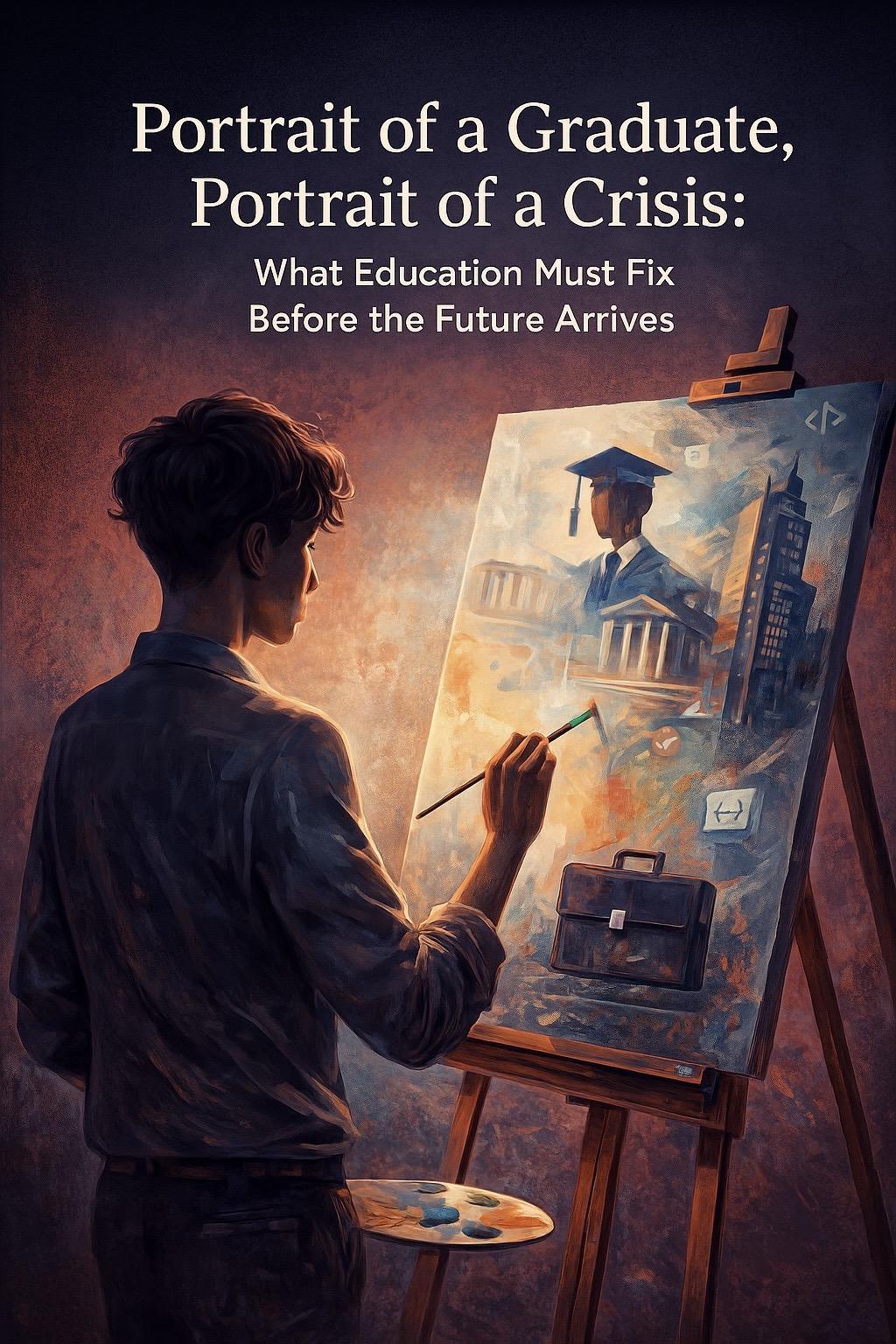
New York State’s Portrait of a Graduate: A Strong Step, But Not the Destination
New York State’s NY Inspires “Portrait of a Graduate,” aligned around six core competencies, represents a smart and necessary shift:
- Creativity & Innovation
- Critical Thinking
- Effective Communication
- Academic Preparedness
- Global Citizenship
- Future-Focused & Reflective Learning
These are the skills that transcend job titles, industries, and economic cycles. They are the human competencies automation struggles to replicate and they reflect what employers, economists, and futurists have been urging schools to prioritize for years.
But while the Portrait is promising, it is also incomplete. Students don’t just need to become critical thinkers and communicators. They need pathways that are adaptable, tangible, structured, industry-aligned pathways, that connect skills to opportunity.
In other words:
- Portrait skills without workforce pathways is a vision without legs.
- Workforce pathways without Portrait skills is a ladder missing rungs.
- The two must evolve together, now, or neither will succeed.
The Harsh Reality: Colleges Are Not Adapting Fast Enough Either
As a principal who maintains deep relationships with alumni, I hear the same refrain again and again:
- “My degree didn’t match the workforce.”
- “Employers wanted experience, not just coursework.”
- “My field changed faster than my program.”
- “I graduated with debt and few entry-level opportunities because AI wiped out the jobs I was training for.”
This is not a knock on higher education, it’s a call for alignment. Colleges were built for a different era, one in which a four-year degree was a reliable entrypoint into the middle class. That era is ending.
This generation faces a new decision-making matrix:
- Do I take on debt for a degree that may not guarantee employability?
- Do I enter a workforce where AI is replacing the jobs once designed for 18-25 year-olds?
- Do I pursue micro-credentials, apprenticeships, or industry certifications instead of, or alongside, traditional college pathways?
The answer, increasingly, is “all of the above,” but our system, with very few exceptions, is not structured to support that.
The Future Will Reward Students Who Are…
AI-Literate, Human-Skilled, and Pathway-Ready. This is where high schools must lead, and a practice we have been cognizant of and developing for th past decade at Staten Island Technical High School.
We need models that blur the lines between:
- high school and career,
- high school and college,
- learning and earning,
- skills and credentials,
- classrooms and industry.
Today’s students must graduate with:
- industry-aligned micro-credentials,
- experiential learning,
- work-based learning hours,
- digital portfolios,
- professional communication and oracy,
- technical literacy,
- AI fluency, and
- real-world, real-resume, real-skill artifacts that employers recognize and trust.
This isn’t about turning high schools into job factories. It’s about modernizing an outdated system to reflect the actual world students are inheriting.
We Have 2–3 Years to Make a Strategic Pivot, or We Risk Failing an Entire Generation
The first graduating class impacted by the new NYS diploma requirements will be entering high school soon. That gives us a sliver of time, a short runway, to get our systems aligned.
In that time, school leaders must:
1. Rebuild secondary education around pathways, not just subjects.
CTE, WBL, Career Development and Occupational Studies (CDOS), and industry micro-credentials must become mainstream, not electives.
2. Treat AI literacy as essential as reading and writing.
Students should learn prompts, ethics, verification, automation, and tool fluency, safely, systematically and responsibly.
3. Forge partnerships with industry at scale.
Businesses, unions, civic institutions, and local employers should shape our programs, not just applaud from the sidelines.
4. Transform assessment.
Move from “regurgitation” to Project / Process based learning and restorative (mastery) assessment, assessing how students learn, iterate, revise, collaborate, and problem-solve.
5. Expand teacher training in AI tools.
Teachers must master the AI technologies already reshaping their fields, and learn to teach students how to wield them responsibly.
6. Align college guidance with economic reality.
Students must understand ROI, debt, employability, and the emergent careers shaped by automation.
A Final Word — From a Principal Who Believes Deeply in the Promise of Public Education
I am not anti-college. I am not anti-technology. I am not anti-innovation. I am pro-student. Period. I want them to be truly future ready.
Ready for any future, not the one we nostalgically imagine, but the one barreling toward them at full speed.
If we fail to pivot now, if we cling to outdated models, outdated metrics, outdated assumptions, the students of this state, and this country, will pay the price.
But if we act with urgency, coherence, and courage, embracing the Portrait of a Graduate while expanding it into a true Portrait of a Future-Ready Citizen, then New York could lead the nation in crafting the most modernized, equitable, and opportunity-rich educational system in America.
We have the tools. We have the data. We have the vision (Future Ready NYC). Now we need the will.
Because the clock is ticking; and the future will not wait for us to catch up.
---------------------------------