“Every one of our students lives in a city Latino people helped build. That is everyone’s history.”
When I was a kid, Black History Month was the shortest month of the year, and somehow, for me, it always felt like the longest.
I remember sitting at my desk while we “celebrated.” We learned about Dr. King. Harriet Tubman. We watched Roots. We saw images of race riots. We learned about chains and auction blocks, fire hoses and dogs, and we heard spirituals and refrains from marches. Those people and those stories had a place because they were part of being Black in America. But it didn’t feel like we were celebrating.
I remember how I felt sitting there. I felt small. I felt like the non-Black kids pitied me... like the lesson was that people who looked like me were people things happened to. We were the ones who suffered. Yeah... I didn’t have the words for it then, and I barely have the words for it now.
What I don’t remember hearing nearly enough about was the joy. Black History Month didn’t seem to touch the richness of the continent my ancestors came from. It didn’t talk much about the ingenuity behind food traditions, the beauty of African architecture and libraries, intricate hairstyles and textiles, or the generations of brilliance, creativity, and invention that were also part of my heritage. Somehow, the story I absorbed was more about victimhood than triumph.
I’ve carried that feeling for a long time. And here we are in September many (many) years later and I’m thinking about it again.
Because right now, many Hispanic and Latino families in Chicago are living with real fear about immigration enforcement… and about whether they belong. That is real, and it is heartbreaking. As school leaders we know our schools cannot shy away from it, because the courage these families and communities are showing deserves recognition too.
But I don’t want a Latino child in one of our schools to sit through Hispanic Heritage Month the way I sat through Black History Month. I don’t want them walking away thinking their story is mostly about borders and survival. I don’t want them to feel like someone else gets to decide when their culture is worthy of celebration... or what is worthy of celebration. No Hispanic student should feel that their culture being given a few weeks on the calendar is some kind of gift they should simply be grateful for. Because Hispanic culture is already worthy of celebration… let’s make sure celebrate is what we actually do.
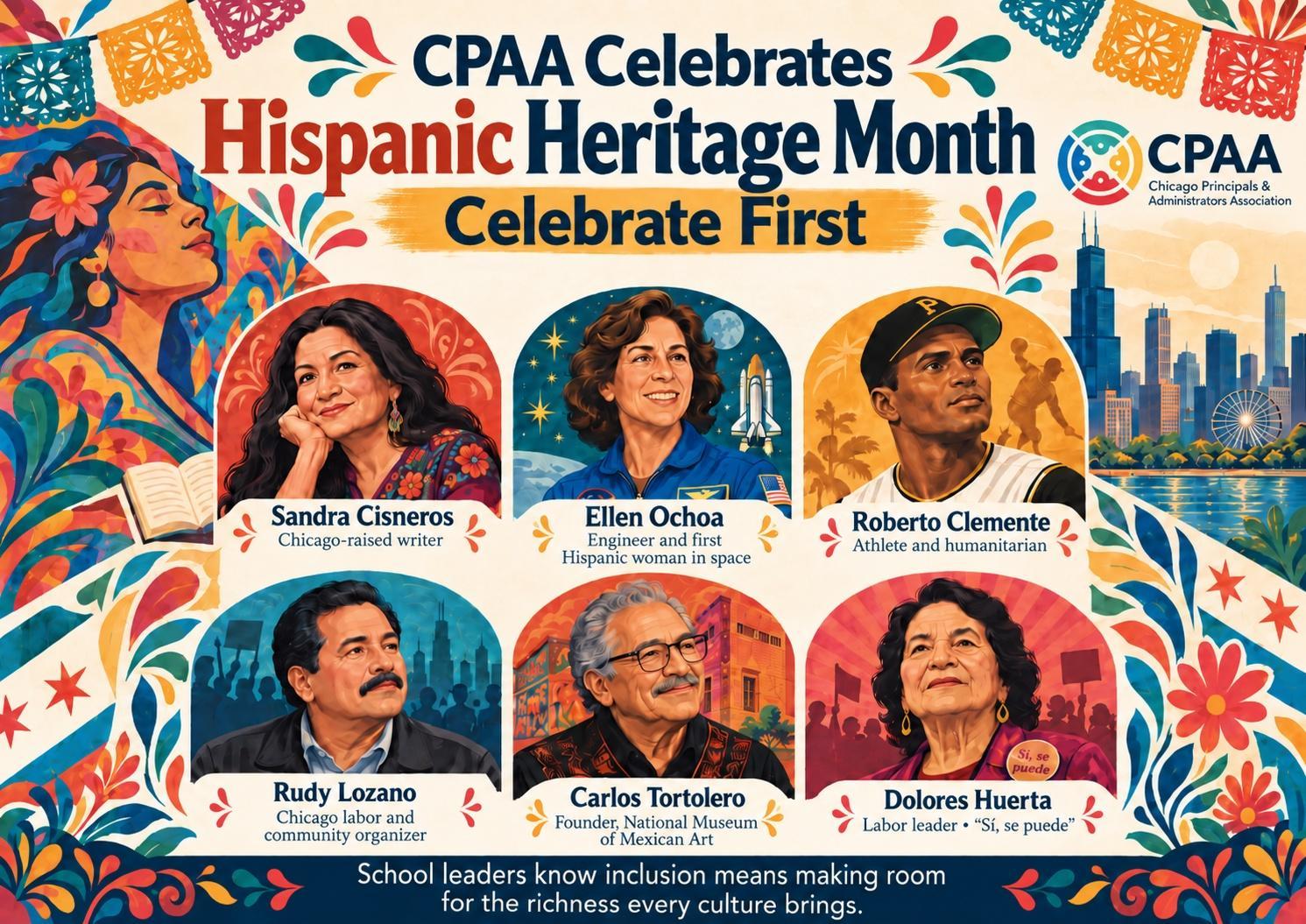
So maybe this is an opportunity for us, as school leaders, to think about what it means to celebrate first. To celebrate the language... including celebrating the children in our schools right now who move between Spanish and English with a skill many adults never develop. Celebrate the art, past and present... from the murals of Pilsen to the work housed inside the National Museum of Mexican Art. And introduce our children to people whose lives reflect the breadth of Hispanic and Latino history. People like:
Sandra Cisneros... Chicago-raised writer whose The House on Mango Street gave us a young Latina imagining a bigger life.
Ellen Ochoa... engineer, inventor, and the first Hispanic woman in space.
Roberto Clemente... legendary athlete and humanitarian whose legacy reaches far beyond baseball.
Rudy Lozano... Chicago labor and community organizer who worked to build coalitions among Latino, Black, immigrant, and working people.
Carlos Tortolero... Chicago educator and founder of the National Museum of Mexican Art, who helped create a space where Mexican art and culture could be centered and celebrated.
Dolores Huerta... labor leader and co-founder of the United Farm Workers who helped give a movement the words “¡Sí, se puede! “(by the way… as a union, that is absolutely history worth knowing by heart).
Let’s think about acknowledging traditions like quinceañeras, Sunday family dinners, posadas, and, of course, our 26th Street parade. Celebrating the paleteros, the corner restaurants, places like Nuevo Leon that generations of families know by name, and the small businesses that help hold whole neighborhoods together. Let’s celebrate the educators, school staff, parents, and students in our buildings right now who are making history we’ll tell later.
And school leaders already understand something important about that. Celebrating a culture doesn’t require belonging to it. We don’t have to be Hispanic to love and honor Hispanic culture. A school does not need a certain percentage of Latino students before that history becomes worth teaching. That said though, nearly 50% of CPS students today are Latino. But here’s another number I love even more: 100% of our students live in a city Latino people helped build. That is proof… Hispanic heritage is part of everyone’s history.
When we celebrate first, the harder stories can land differently. Children can hear about struggle and resistance with pride instead of shame because they already know the fuller story of who they are. They know they come from people who created, built, laughed, cooked, healed, danced, fought, loved, and thrived. That’s what I didn’t get as a kid... but it’s what every one of our students deserves.
So this month, let's lead with joy. The struggle still belongs in the story, and we will teach it. But when children first learn how much there is to be proud of, they hear that history with their heads held high. That's the work in front of us as school leaders. And as Dolores Huerta taught a movement,
¡Sí, se puede!